
What the 2026 Australian Business in ASEAN Survey Means for Australian Businesses: A Singapore Perspective
Singapore briefing | 29 September 2026
Southeast Asia continues to hold strong appeal for Australian businesses, but confidence in the region is being balanced by a more cautious approach to growth, investment and expansion.
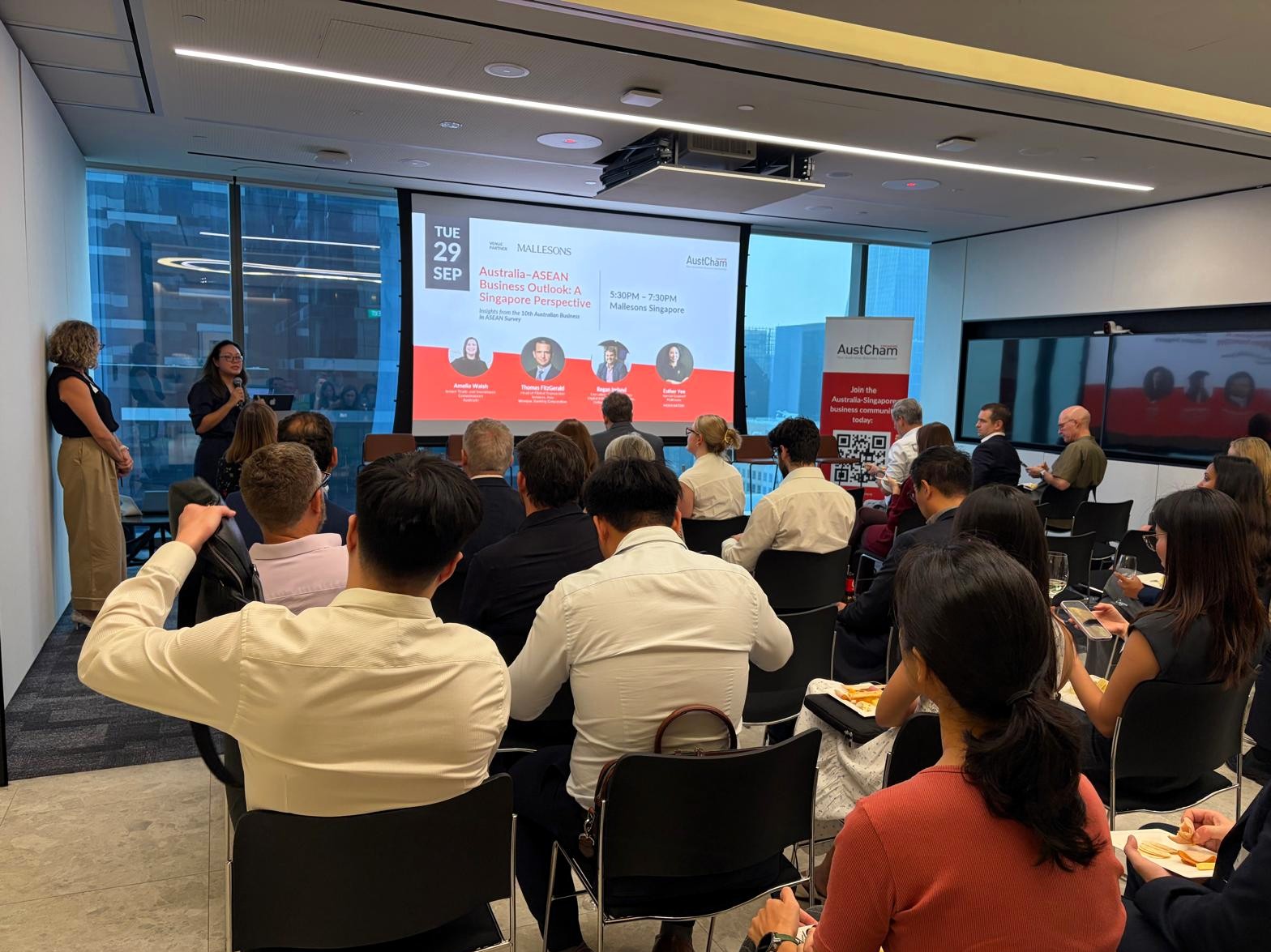
That was one of the key themes from the Singapore briefing of the 2026 Australian Business in ASEAN Survey, hosted by AustCham Singapore in partnership with Mallesons on 29 September 2026.
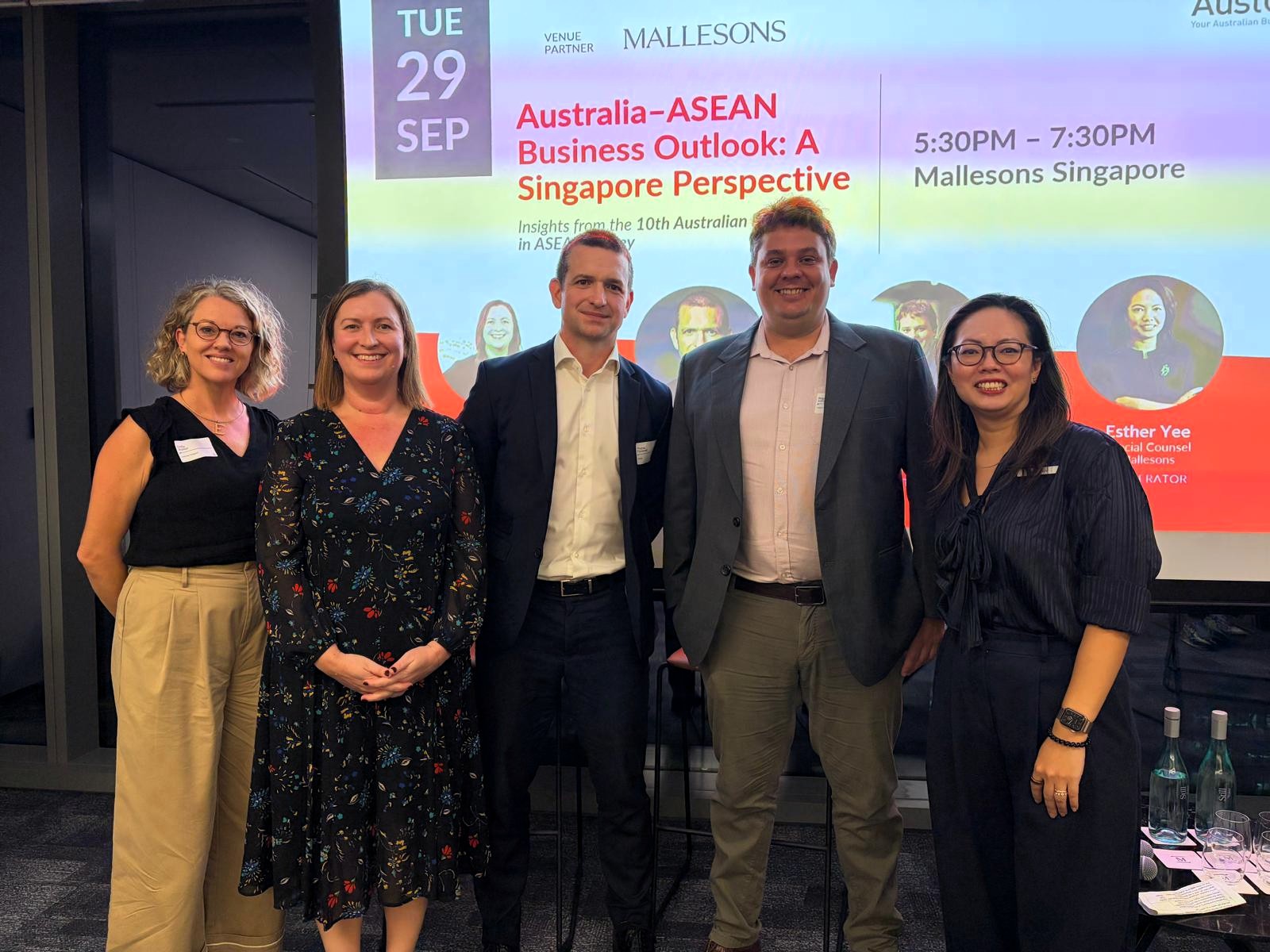
Now in its tenth edition, the survey provides a decade of insights into how Australian businesses view opportunities and challenges across Southeast Asia. The 2026 findings draw on responses from businesses across 11 Asian markets and are intended to inform both business decision-making and government engagement on trade, market access and regional economic cooperation.
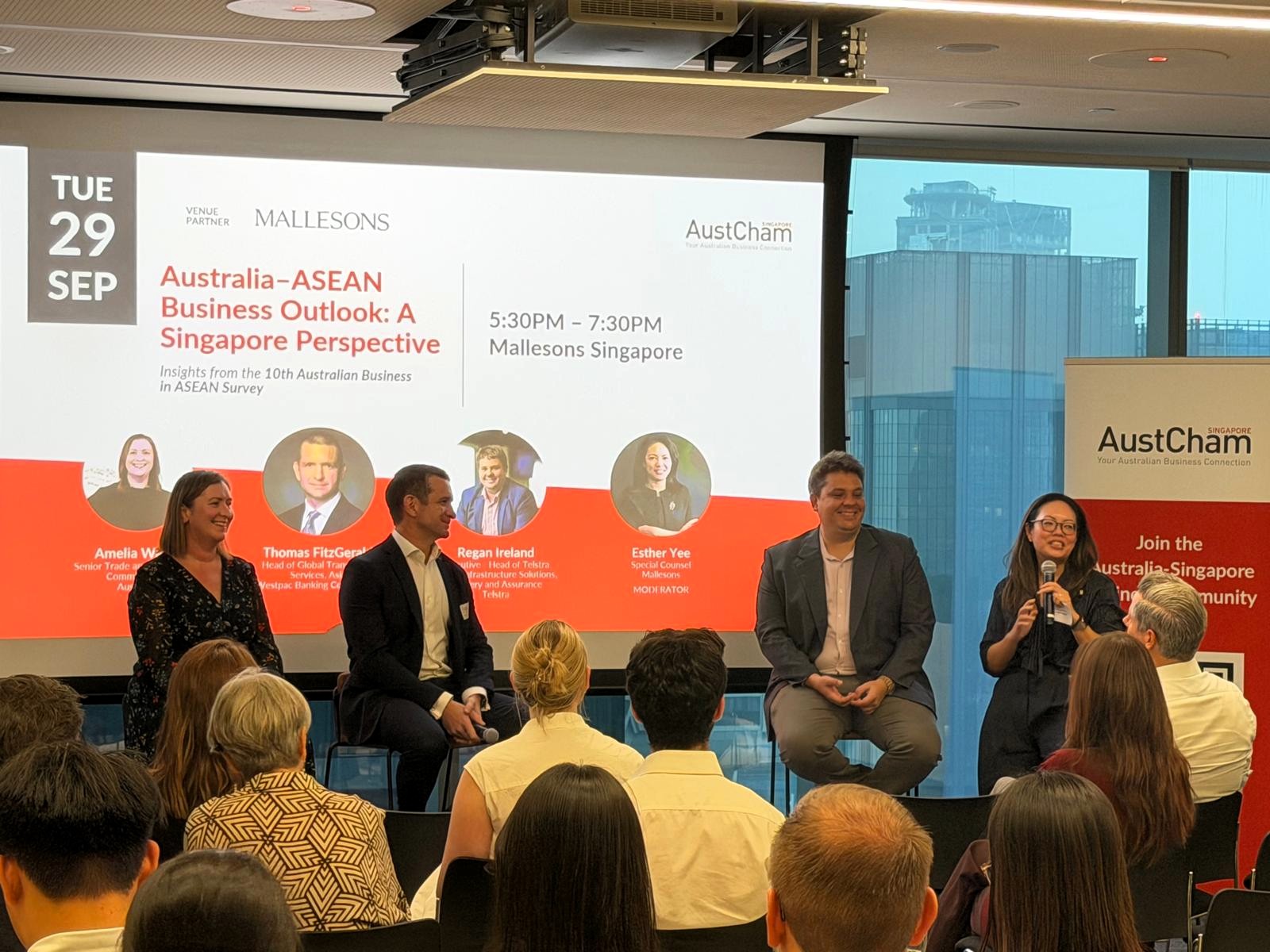
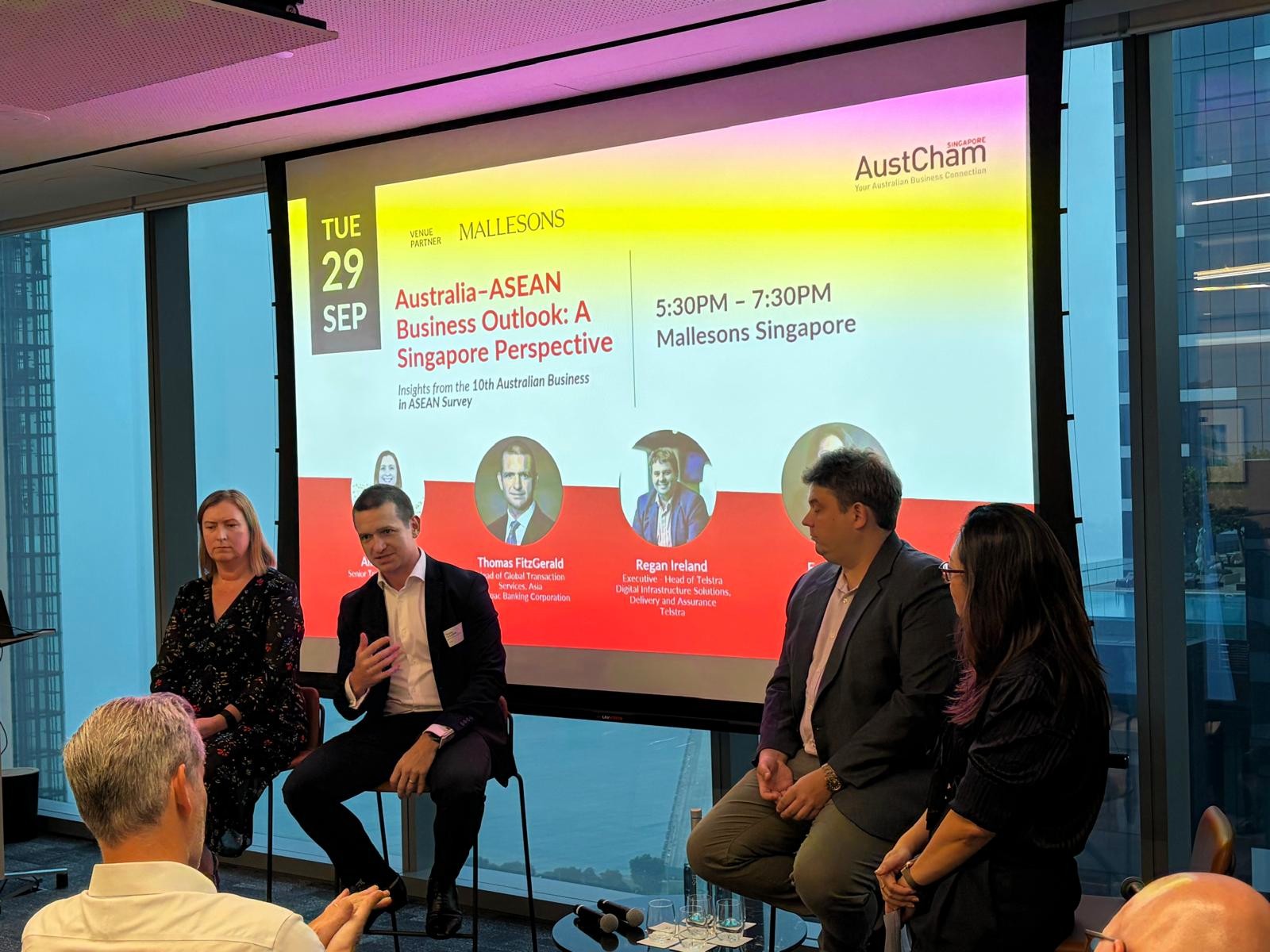
At the Singapore briefing, Amelia Walsh, Senior Trade and Investment Commissioner at Austrade, presented the key findings before joining Thomas FitzGerald, Vice President of AustCham Singapore and Head of Global Transaction Services, Asia at Westpac, and Regan Ireland, Executive – Head of Telstra Digital Infrastructure Solutions, Delivery and Assurance, for a panel moderated by Esther Yee, Special Counsel at Mallesons.
Together, they explored what the findings mean for Australian businesses, and why Singapore continues to play an important role in connecting Australia with the wider region.
Confidence remains strong, but businesses are navigating greater uncertainty
The survey shows that businesses remain positive about Southeast Asia’s longer-term prospects, while taking a more measured approach to the current environment.
59% of respondents reported being very or extremely confident about sustaining and growing their business in Southeast Asia. At the same time, 35% said the previous six months had been challenging, reflecting global political uncertainty, supply chain disruption and broader economic volatility.
The panel saw this mix of confidence and caution reflected in their own businesses and customer relationships.
For Thomas FitzGerald, the growth opportunity across Asia remains compelling, but businesses are increasingly focused on resilience, disciplined capital allocation and identifying where durable growth is likely to come from.
For Regan Ireland, Telstra’s focus on Asia-Pacific and ASEAN reflects the region’s strong potential. Singapore has become an increasingly important base for the company’s international operations, particularly as demand grows for digital infrastructure, connectivity and subsea cable capacity.
Singapore continues to serve as a launchpad into the region
Singapore’s position stood out as somewhat different from the broader ASEAN picture.
68% of Singapore respondents reported being extremely or very confident about business conditions in Singapore, while governance and regulatory barriers were less pronounced than in other ASEAN markets.
For Australian businesses, Singapore’s role as a regional hub therefore remains significant.
Amelia Walsh described a continuing “land and expand” model, where businesses use Singapore to build confidence, gain experience in Asia and establish regional capabilities before expanding into other markets.
The panel also highlighted how Singapore’s role extends beyond being a headquarters or landing pad for investment. Its regulatory stability, connectivity, infrastructure and concentration of regional expertise allow businesses to use Singapore as a base for exploring other Southeast Asian markets.
At the same time, businesses need to think carefully about where they locate people and operations. Different markets offer different advantages in terms of customers, talent, costs and capabilities.
ASEAN Chairmanship 2027: an opportunity to deepen engagement
Singapore’s upcoming ASEAN Chairmanship was another key focus of the discussion.
For Australia and Australian businesses, this creates opportunities to deepen regional engagement and raise awareness of Singapore as a base for growth.
Amelia Walsh highlighted connectivity as an important theme, particularly across the digital economy and energy, with opportunities in areas such as cross-border energy, digital trade and regulatory cooperation.
The ASEAN Digital Economy Framework Agreement (DEFA) was also highlighted as an area to watch. Greater interoperability across data, cybersecurity, digital payments and digital identity could make it easier for businesses and consumers to operate across borders.
For Australian businesses, the opportunity is not simply to participate in the commercial activity generated by the Chairmanship, but to engage with the broader conversations shaping the region’s economic architecture.
Digital growth will depend on infrastructure as well as innovation
AI, digital infrastructure and connectivity are increasingly shaping competitiveness across ASEAN, but the panel noted that physical infrastructure needs to keep pace with rapidly growing demand.
Singapore is already highly connected, but constraints around land and power are creating opportunities for regional partnerships. Connections with neighbouring markets such as Malaysia could complement Singapore’s role as a digital hub.
The rapid growth of AI is also putting pressure on digital infrastructure. Subsea cables, data centres and other infrastructure require significant investment and long lead times, creating a potential gap between demand and available capacity.
The discussion therefore extended beyond technology to the wider ecosystem needed to support digital growth — including energy, connectivity, standards and regulatory cooperation.
The panel also noted that community engagement and ESG considerations need to be built into data centre and energy infrastructure projects from the outset.
Navigating ASEAN requires local knowledge and relationships
While Singapore was seen as comparatively straightforward from a regulatory perspective, governance and regulatory challenges remain significant barriers across ASEAN.
The panel highlighted how different these challenges can be from one market to another. For businesses operating physical infrastructure across multiple countries, regulatory considerations can extend well beyond traditional business approvals. Telstra’s experience with subsea cables, for example, involves territorial waters, permits, military activity, shipping and fishing interests, as well as relationships with local partners and regulators.
For businesses entering a new market, the challenges can also be more practical: opening a bank account, understanding tax and accounting requirements, hiring the right people and navigating local documentation.
The message was clear: local relationships, trusted partners and market knowledge remain critical assets when expanding across ASEAN.
Find the right people and get involved
Asked what advice they would give an Australian executive considering expansion into Southeast Asia, the panel returned to one theme: people.
Finding the right people - both within the business and through the wider business community - can be one of the most important early investments a company makes.
The region has an established network of businesses, chambers, government agencies and professional services organisations that can help companies understand markets, test opportunities and navigate challenges.
For Australian businesses, this means they do not have to navigate the region alone. Government agencies, state and territory representatives, chambers and established businesses can all provide valuable local knowledge and connections.
Looking towards 2030
The discussion closed with a forward-looking question: what trend or strategic shift could have the greatest impact on Australian businesses operating in ASEAN by 2030?
The panel pointed to greater regional connectivity and interoperability.
That connectivity will be physical - through energy, infrastructure and telecommunications - as well as digital, through common standards, digital trade, interoperable payment systems and greater regulatory alignment.
For Australia, the opportunity lies in becoming increasingly connected to the region and participating in the partnerships shaping its future growth.
As Southeast Asia becomes more integrated, Australian businesses will need to look beyond individual markets and consider how their capabilities, people, partnerships and operations can work across the region.
Singapore will continue to play an important role as a regional hub, a source of expertise and capital, and a launchpad for businesses looking to build a presence across Southeast Asia.
Key Takeaways
- Confidence in Southeast Asia remains strong. Businesses continue to see significant long-term growth opportunities, even as global uncertainty creates greater short-term caution.
- Singapore remains an important regional launchpad. Its stability, connectivity, infrastructure and concentration of regional expertise make it a valuable base for Australian businesses.
- ASEAN Chairmanship 2027 creates new opportunities for engagement. Australia and Australian businesses can participate in conversations around regional economic cooperation, digital trade, energy and connectivity.
- Digital growth needs physical infrastructure. AI and digital demand are creating opportunities, but investment in connectivity, data centres, energy and subsea infrastructure will need to keep pace.
- Local knowledge matters. Relationships, trusted partners and an understanding of local regulatory and business environments remain critical to successful expansion.
- The region is not one market. Businesses need to consider where their customers, talent and operations should be located, rather than applying a single regional model.
- Australian businesses need to be part of the region. The message from the panel was simple: build relationships, get on the ground, find the right people and engage with the wider business community.
About the Australian Business in ASEAN Survey
The 2026 Australian Business in ASEAN Survey is produced by AustCham ASEAN in partnership with RMIT University, with support from the Australian Government through DFAT and Austrade. It provides a snapshot of how Australian businesses view the region today.
The 2026 Australian Business in ASEAN Survey is available via the AustCham ASEAN and AustCham Singapore websites. Download the Survey on our Publications page here.